Kent State University

Sharon Public Library

How might we evaluate our current existing site content and improve finding information?
Role M.S. User Experience Design Candidate
Channel Responsive Web
Timeframe 6 months
Overview Sharon Public Library serves as a civic destination for literacy, cultural arts, and community engagement; the project focused on evaluating existing site content and improving findability for patrons across diverse technology-literacy levels.
Contribution Conducted discovery research, remote user interviews, tree tests, and click-tests; produced information architecture recommendations, low-fidelity wireframes, and prototypes to improve navigation and accessibility.
Problem Over 2,000 indexed pages with outdated links and inconsistent organization made it difficult for patrons to find relevant information; the site lacked modern accessibility practices.
Hypothesis Consolidating and simplifying content, improving labels, and replacing PDF-centric pages with HTML will improve findability and accessibility for patrons.

Overview

Sharon Public Library is a destination that serves as a civic space encompassing literacy, cultural arts, and community programming. The project aimed to evaluate site content and navigation to make it easier for patrons to find information and services.

Problem

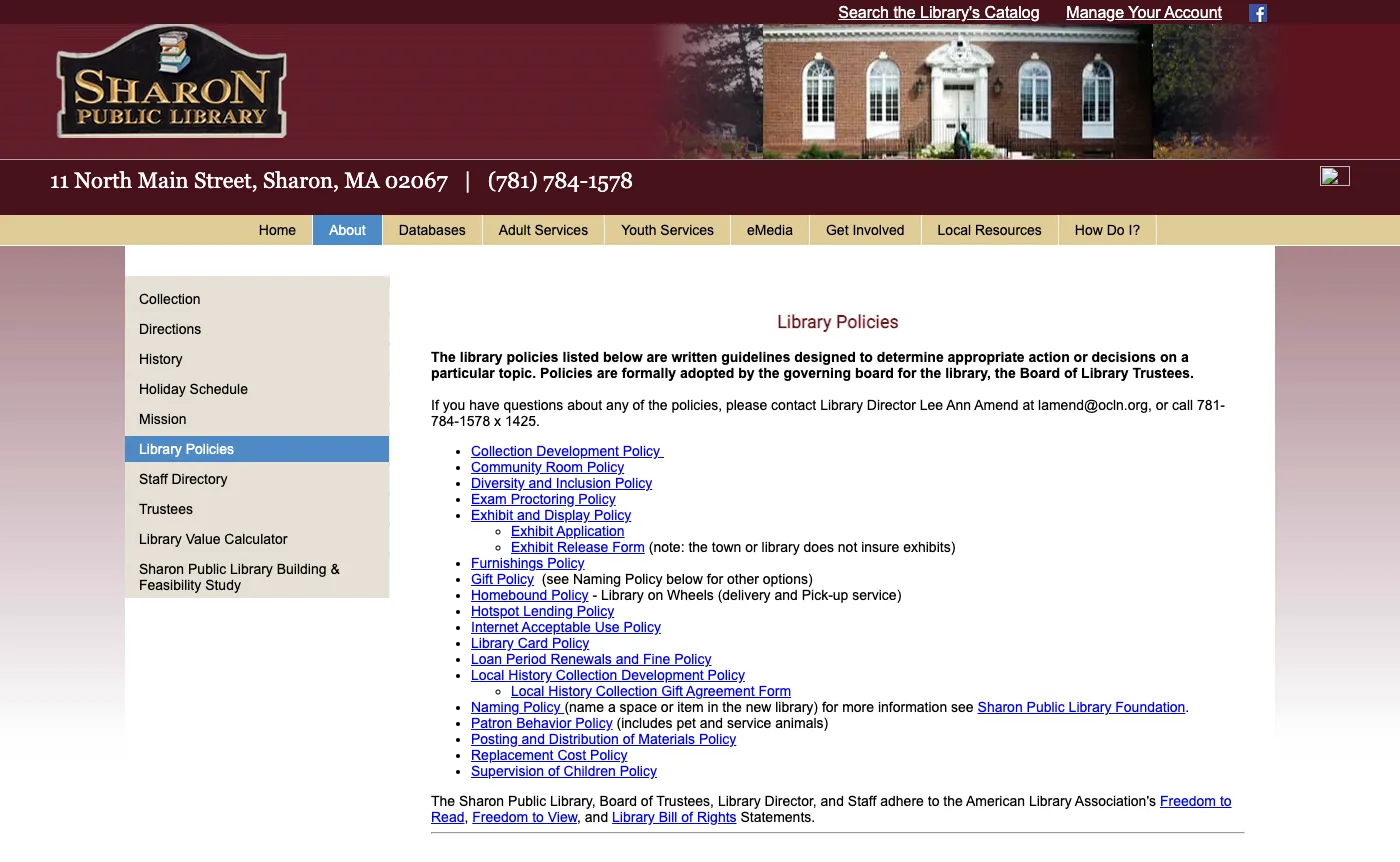
Over 2,000+ pages indexed created navigation difficulties; many links were outdated or no longer functioning.The website was not fully ADA compliant and lacked modern technical practices, creating barriers for users with accessibility needs.
  • 01
    Digital content overload

    A large volume of pages and redundant content reduced discoverability for key tasks.

  • 02
    Accessibility gaps

    Outdated templates and PDF-heavy content presented barriers to users with assistive technologies.
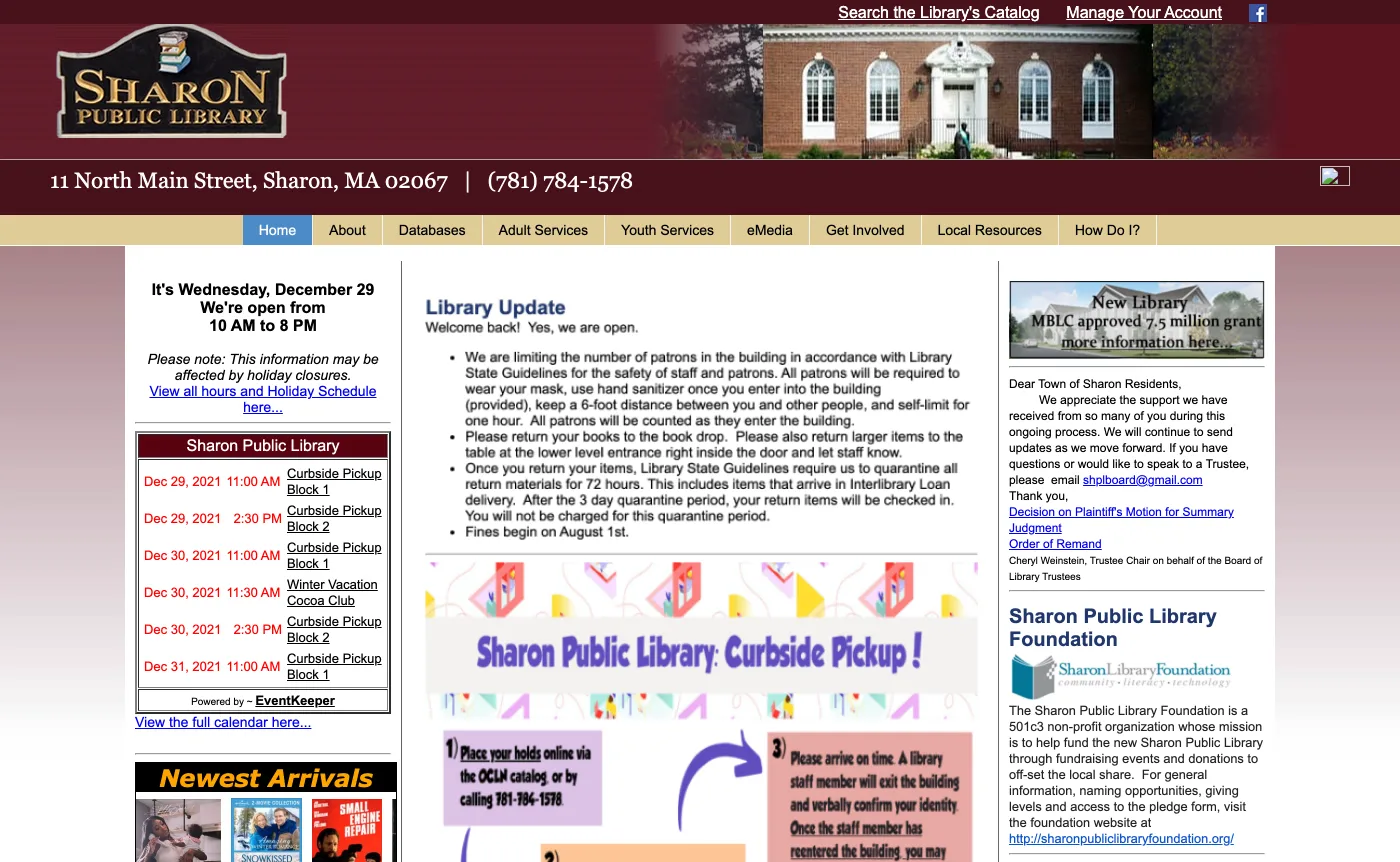
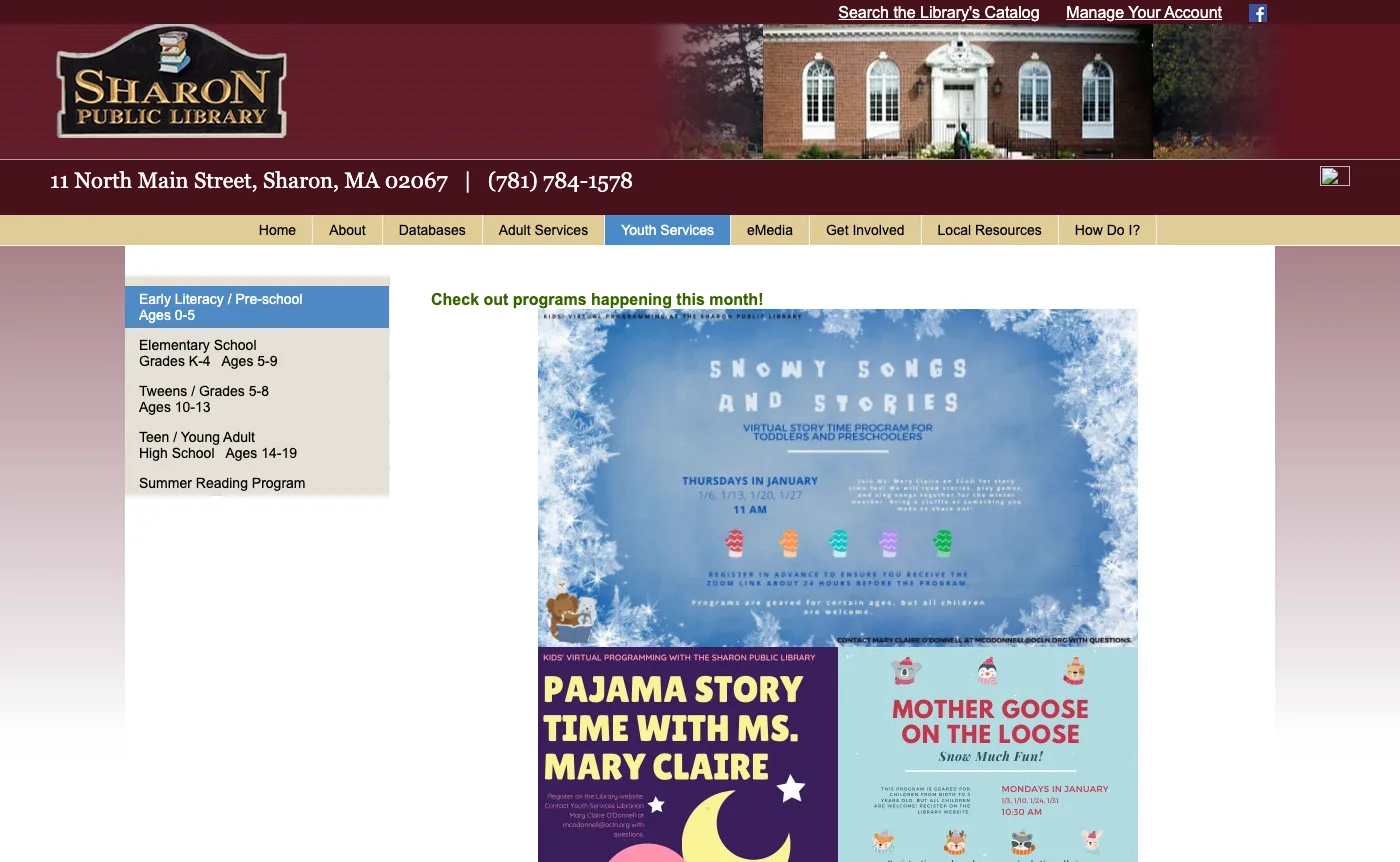
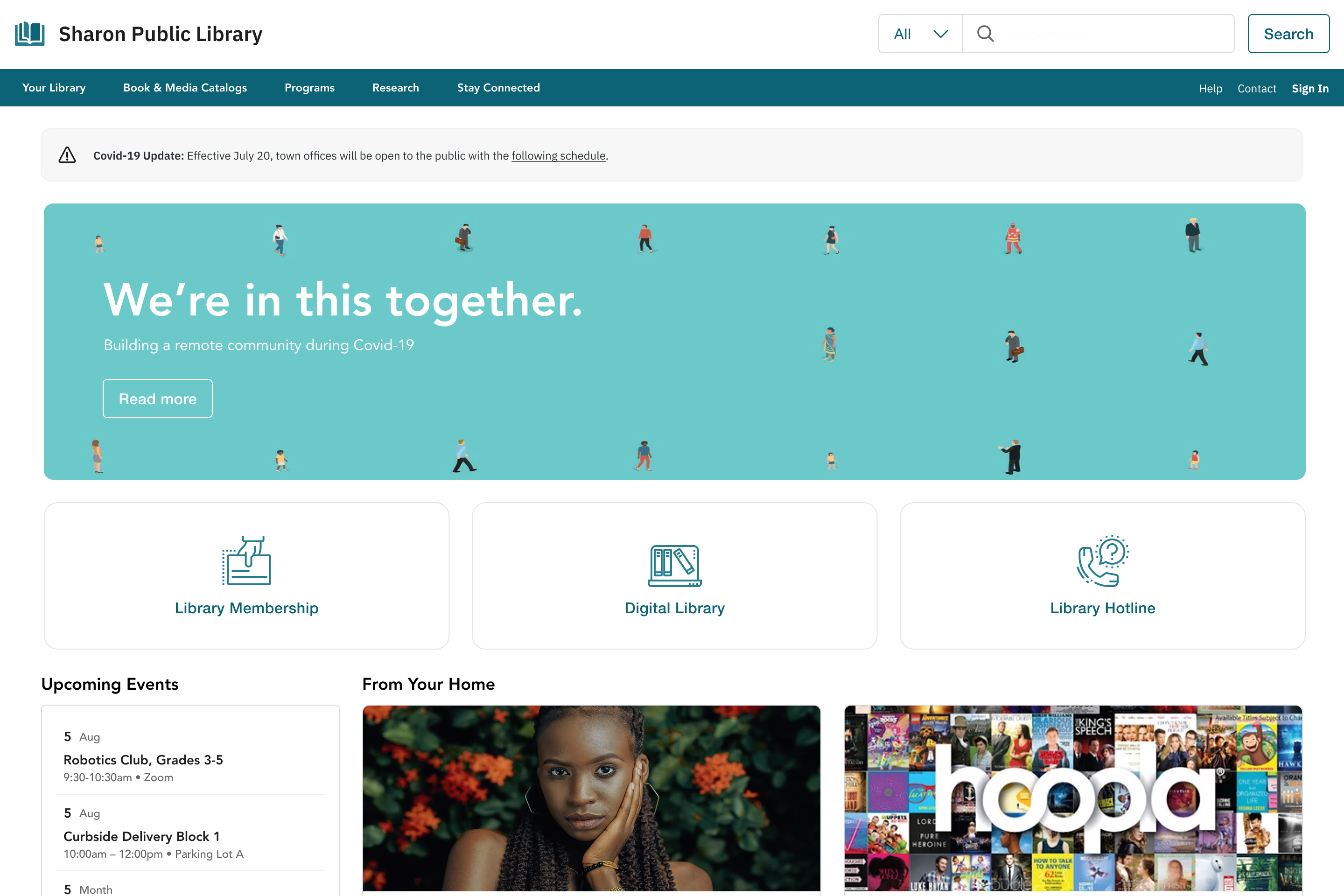
Current homepage
Current homepage
Embedded images with text
Exhaustive external and internal links

Solution

Propose an improved information architecture, consolidate outdated content, migrate key pages from PDF to HTML, and introduce a lightweight design system to meet accessibility requirements.
  • 01
    Improved information architecture

    Consolidated and pruned content to surface relevant pages and reduce navigation depth.

  • 02
    UI and accessibility enhancements

    Introduced consistent UI patterns and guidance to support ADA compliance and better usability.

Approach

To deepen understanding of patrons, conducted discovery, remote interviews, retrieval usability tasks, and content analysis to drive IA recommendations and prototype designs.
Insights
  • Technology comfort varies by age; older patrons showed lower digital literacy.
  • Computer hardware and Wi‑Fi availability influence visits to the physical library.
  • Content databases maintained manually can conflict with digital records, creating patron friction.
  • HOOPLA and downloadable media are high-value services for patrons.
  • Pandemic conditions increased reliance on digital resources and highlighted gaps in online services.
Recommendations
  • Monitor content usage and archive stale pages older than ~5 years.
  • Favor HTML pages over PDFs to improve searchability and accessibility.
  • Consolidate navigation and adopt clearer labels informed by card-sorts and tree tests.
  • Introduce signed-in experiences for personalized services (checkouts, reservations).
  • Surface trending content and FAQs to reduce support load.
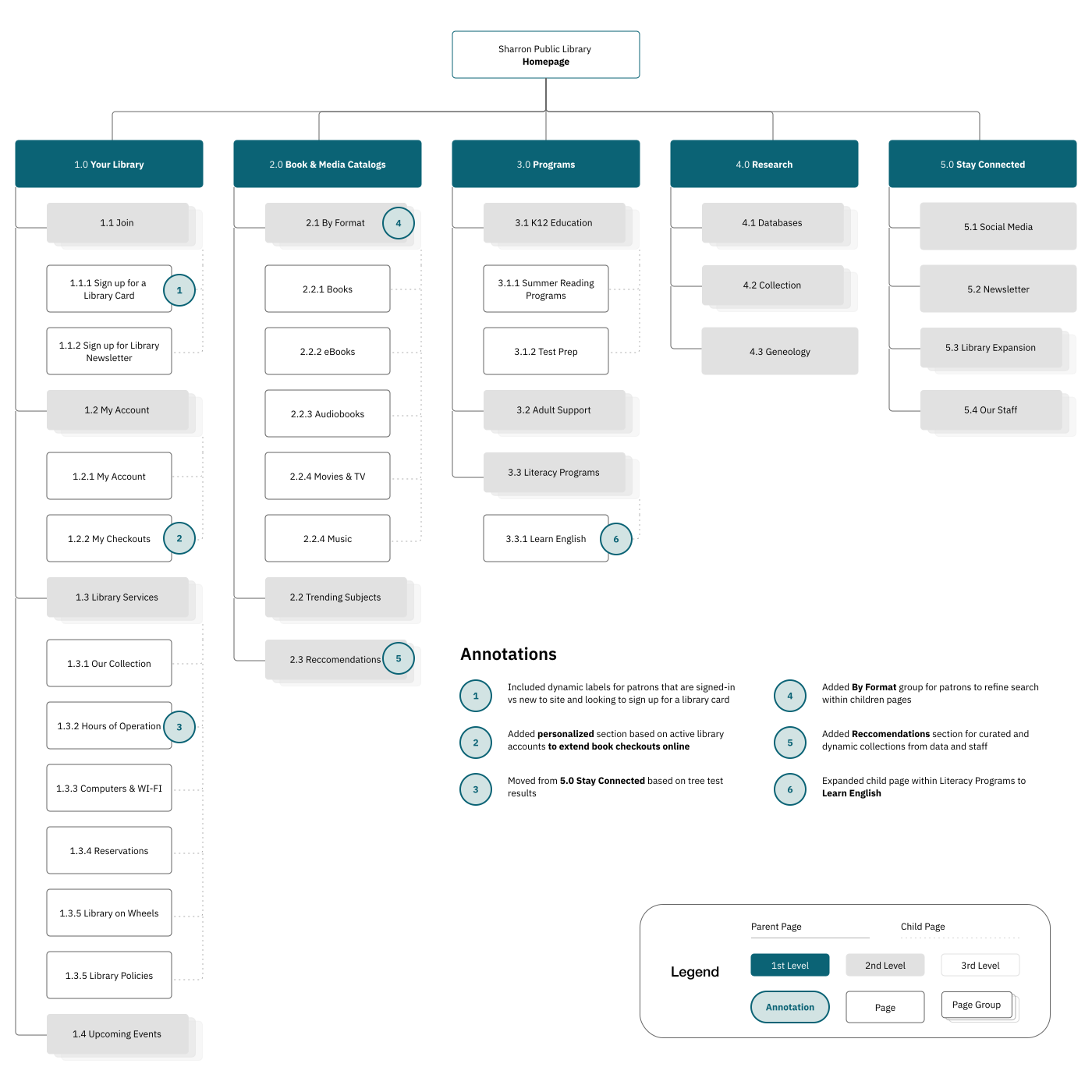
Proposed sitemap
Proposed sitemap
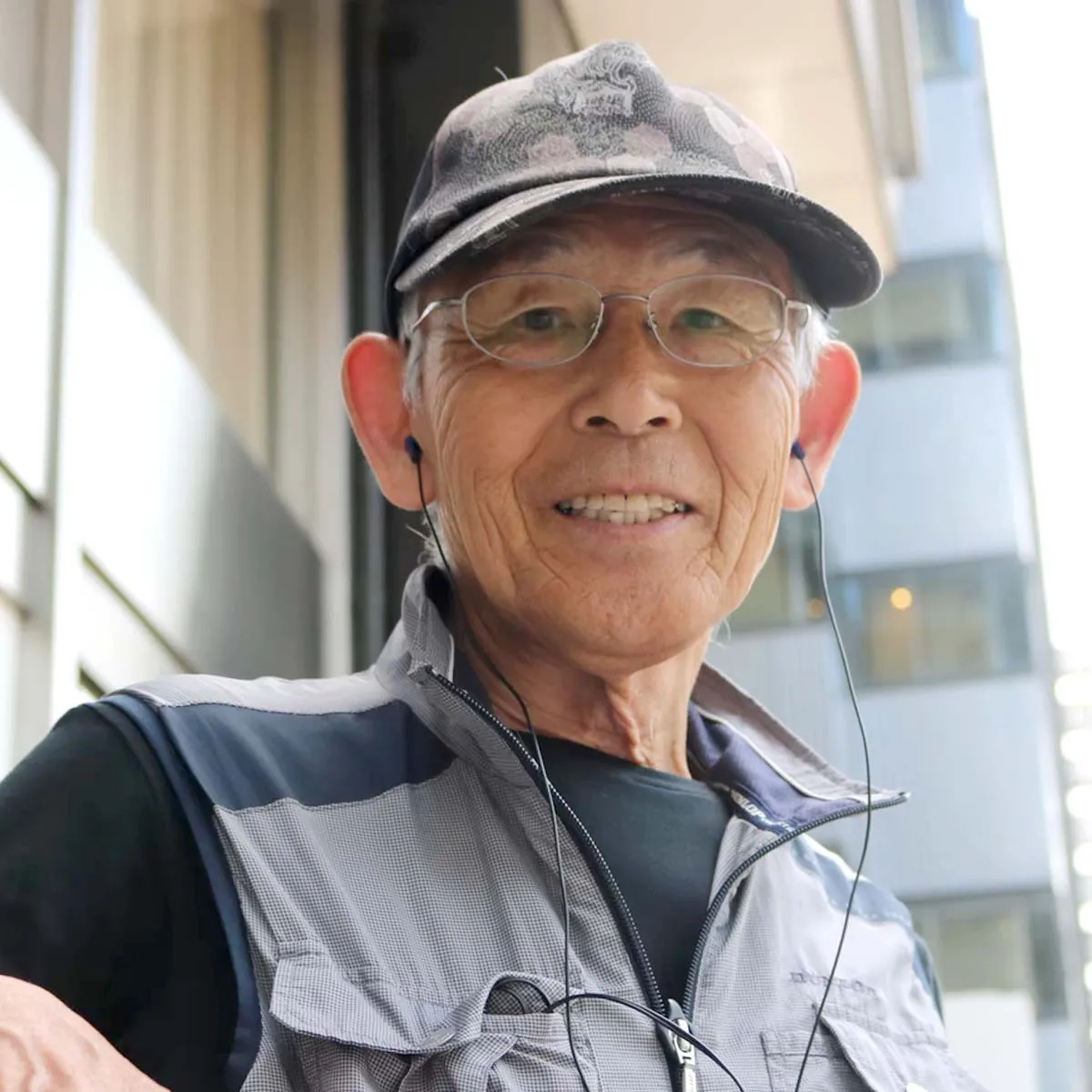
The Informant"I like to stay informed and be able to anticipate where I can find answers to all types of questions."
35 years oldOhioLibrary Branch Clerk
Becca has worked twelve years as a branch clerk across multiple libraries; she supports patrons, adapts to changing services, and helps surface community resources.
  • Make it easier for patrons to navigate physical and digital channels.
  • Promote diverse and inclusive programming.
  • Rely on databases to find information
  • Provide both physical and digital support
  • Attend workshops to learn new skills
  • Physical materials not matching digital listings
  • Shared licensing limitations for electronic services
  • Patron complaints about website discoverability
Ideation

Co-creation of IA recommendations and wireframes was informed by tree tests and card-sorts; ideation focused on consolidating labels and reducing cognitive load.
Display groups of related content by type to reduce navigation depth.
Organize groups of information Display groups of related content by type to reduce navigation depth.
Use clearer labels and hierarchy informed by test results.
Introduce a tree nav Use clearer labels and hierarchy informed by test results.

Wireframes

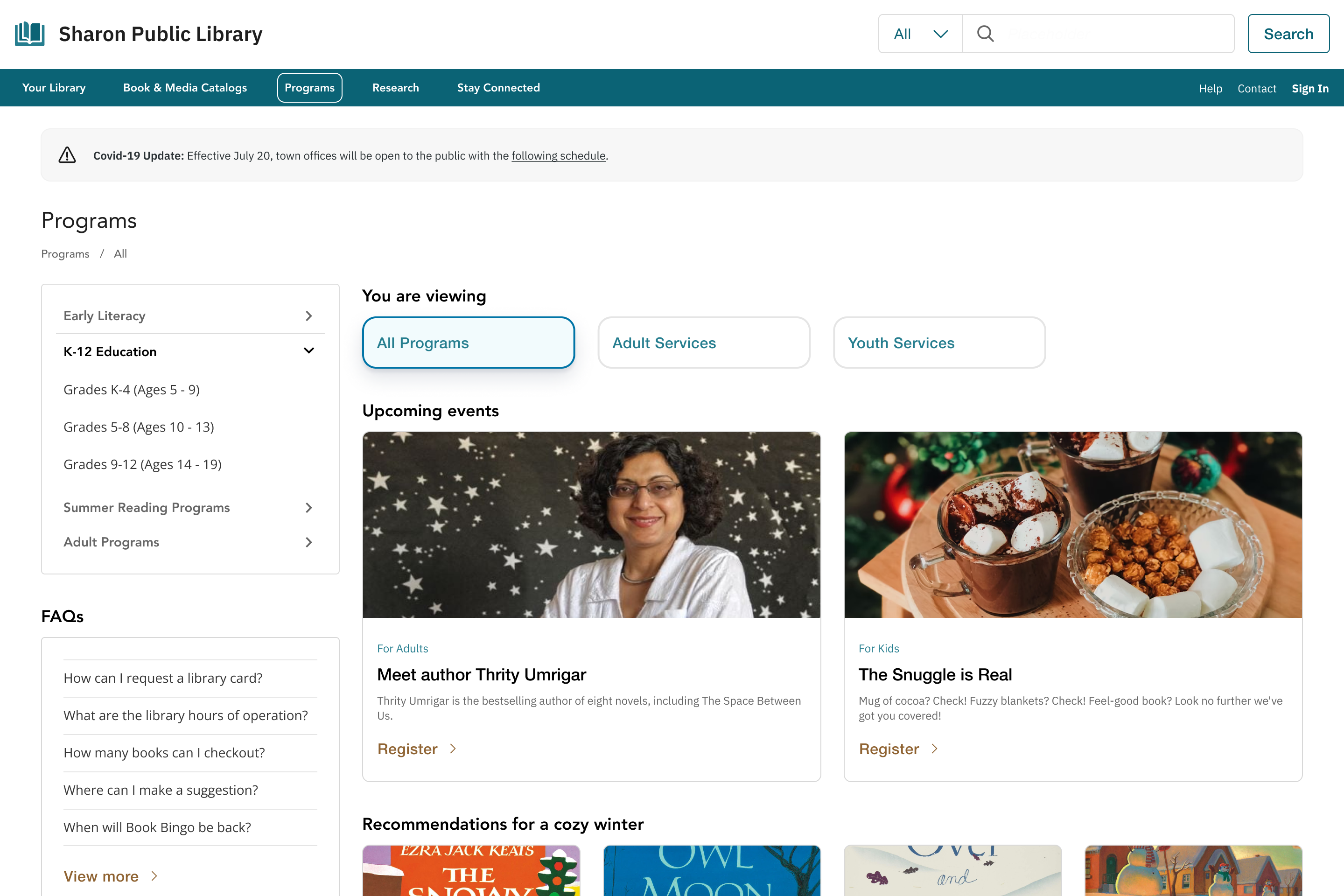
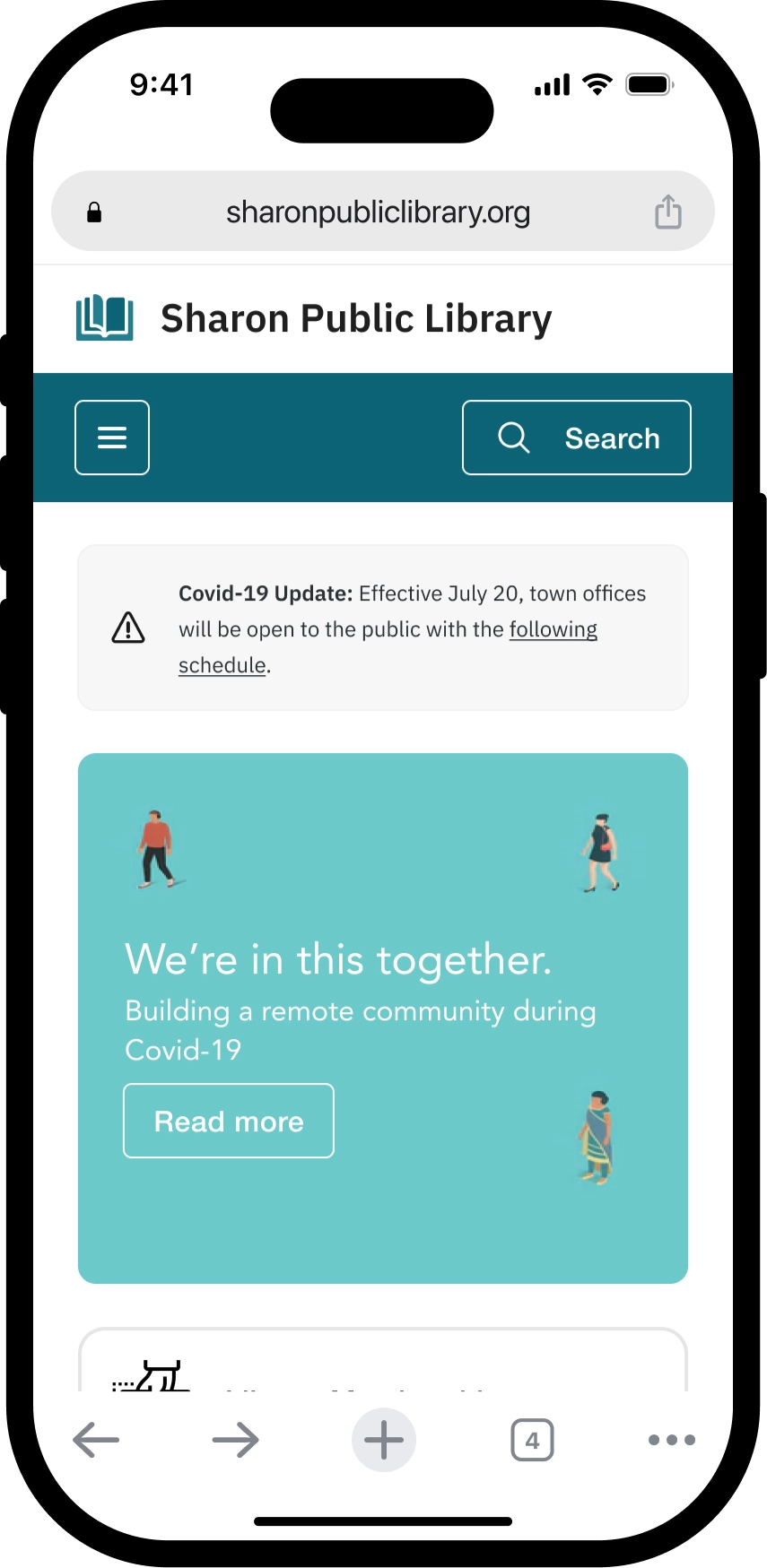
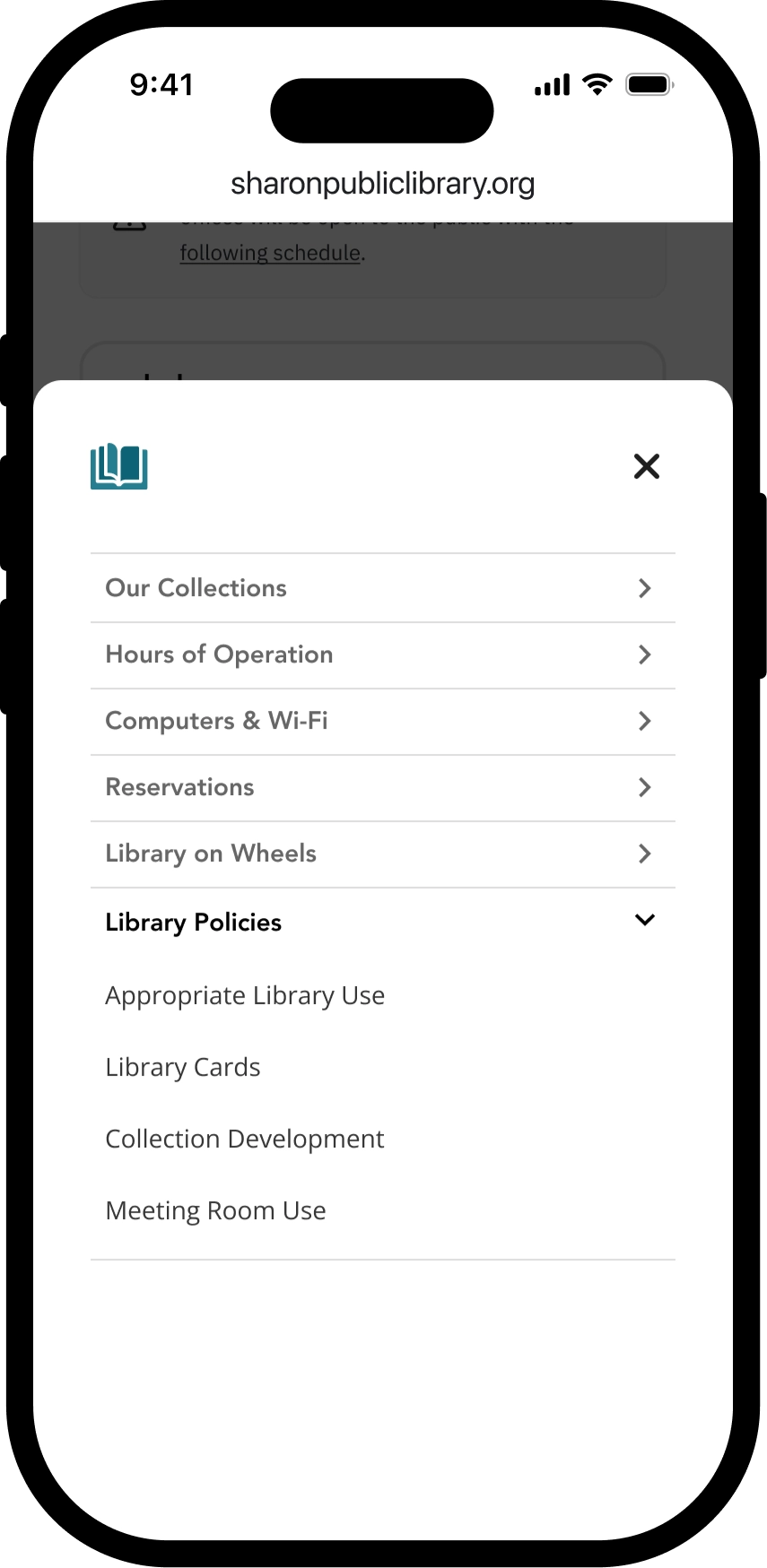
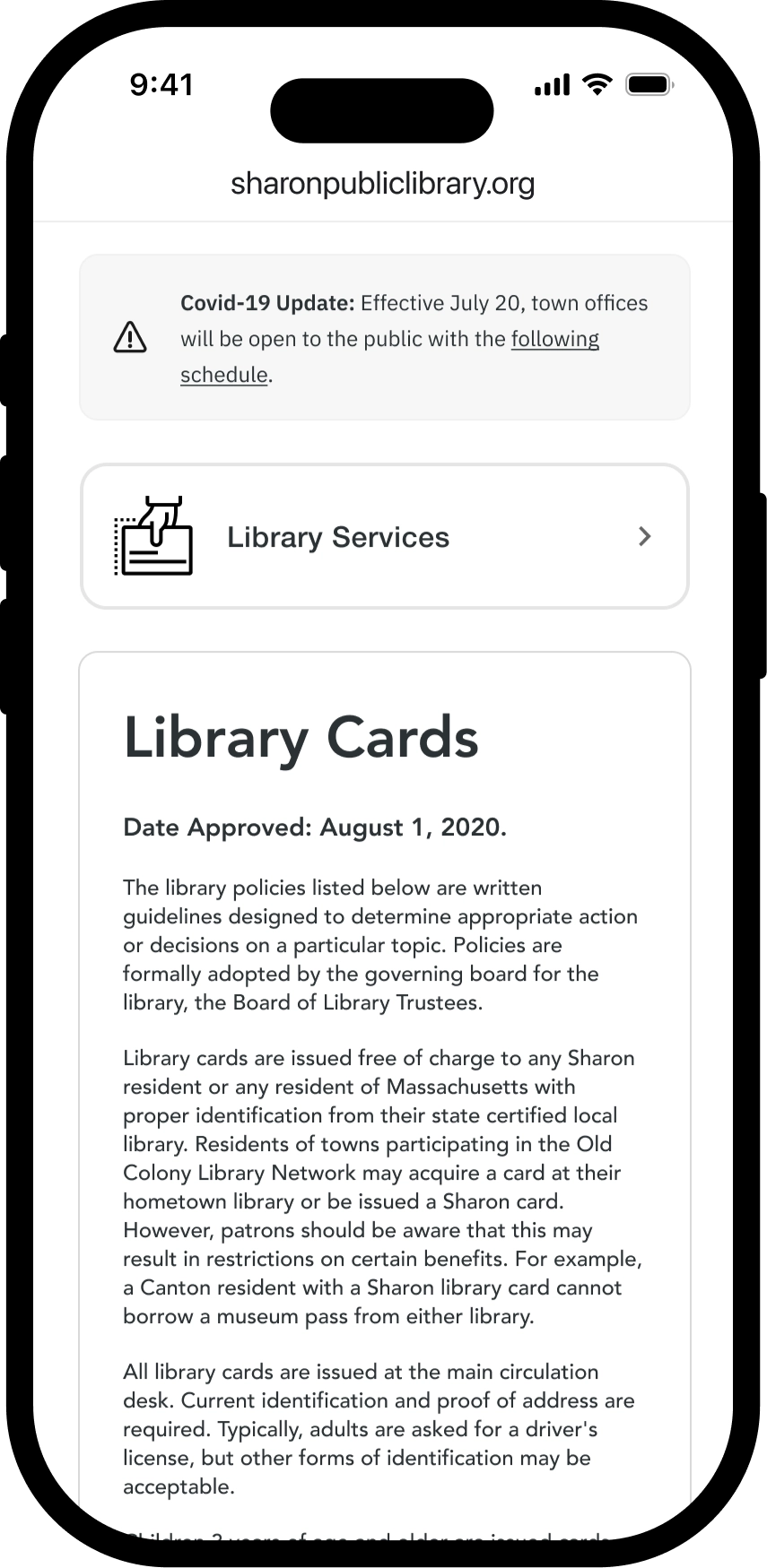
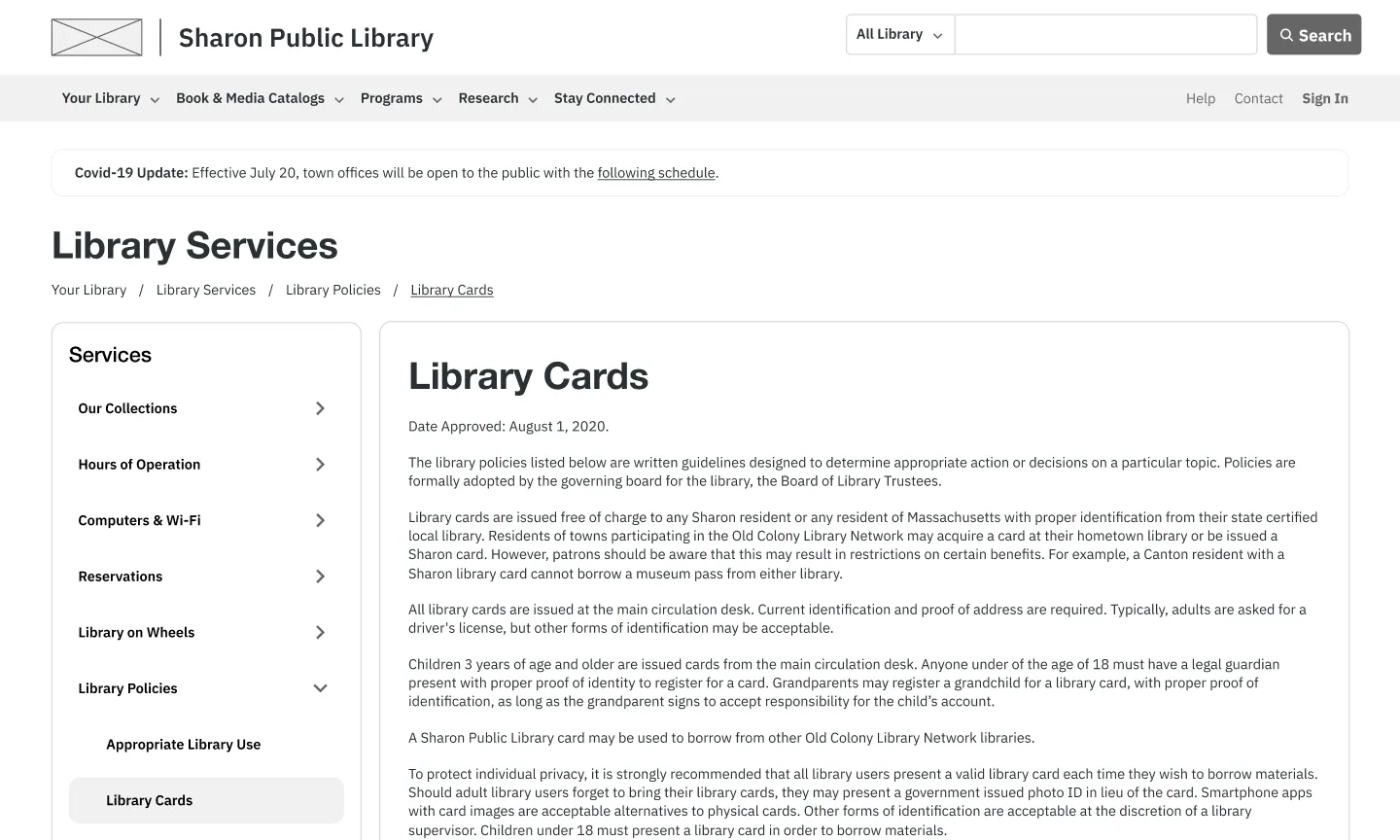
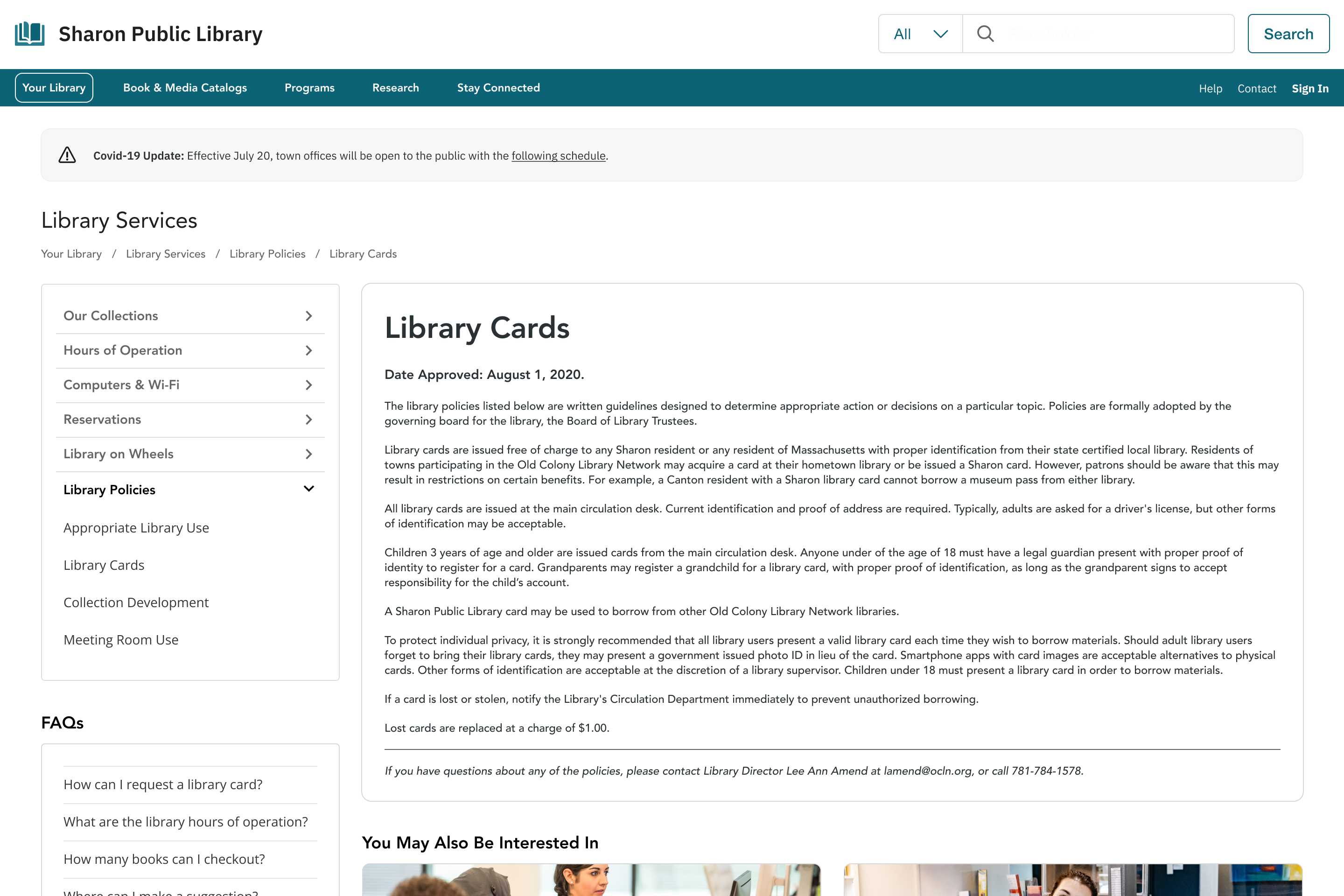
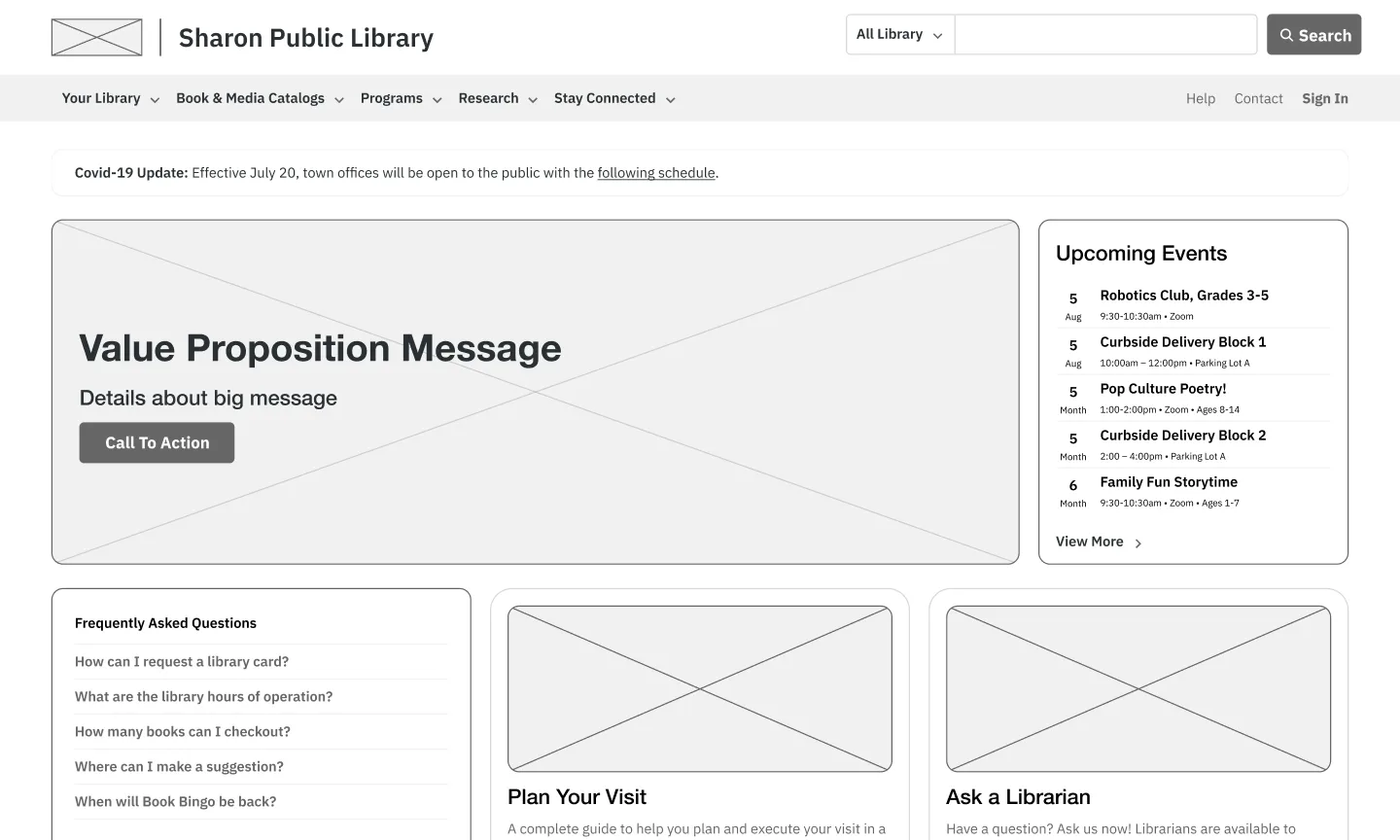
Wireframes visualize new navigation patterns, homepage optimizations, and streamlined content pages for easier retrieval.
HomepageReimagined to reduce clicks for high traffic content
Reimagined to reduce clicks for high traffic content
New Information ArchitectureRedefined navigation schemes
Redefined navigation schemes
Frequently Asked QuestionsSupport topics, simplified
Support topics, simplified

Takeaway

Information architecture is critical; prioritize user feedback and iterative testing to refine navigation and accessibility.
Lessons learned
  • Advocate for user feedback and iterate based on insights.
  • Start with user-centric IA and validate with testing before visual design.
  • Remain flexible; out-of-scope items may be future opportunities.
Potential next steps
  • Conduct user testing for both web and mobile.
  • Evaluate third-party integrations and accessibility fixes.
  • Ideate personalization to focus on sentiment metrics.
Sharon Public Library Website Redesign Improving information architecture and accessibility for civic library serving diverse community needs

CDO Priority Set expectations for brevity (15 min), establish credibility, preview your direct leadership impact. Say Your title, company context, the business problem scale. Emphasize "I led" statements, quantifiable scope (users, teams, timeline). Avoid Generic team language—focus on YOUR role/decisions.

Context The Challenge
  • Organization Kent State University is a public research university in Kent, Ohio, known for its strong programs in education, business, and the arts, fostering innovation and community engagement.
  • Problem Over 2,000 indexed pages with outdated links and inconsistent organization made it difficult for patrons to find information
  • Scope Public library website serving diverse community with varying technology literacy levels and accessibility needs
  • Timeline 6 months
  • Role M.S. User Experience Design Candidate

CDO Priority Demonstrate strategic context awareness—why this mattered to the business. Say Root cause (acquisitions, tech debt, org structure), business cost/impact, constraints that made it hard. Emphasize Why YOU were brought in, executive stakes, urgency. Keep under 60 seconds.

Context My Role & Impact
  • User Research Conducted discovery research, remote user interviews, and retrieval usability tasks
  • Information Architecture Created IA recommendations through tree tests and card-sorts to improve navigation
  • UX Design Produced low-fidelity wireframes and prototypes to improve findability
  • Accessibility Focus Addressed ADA compliance gaps and proposed HTML migration from PDFs
  • Content Strategy Recommended content consolidation and archiving strategies

CDO Priority Prove you led hands-on AND strategically. Say Specific actions YOU took (audited, designed, trained), tactical deliverables with YOUR fingerprints. Emphasize Leadership evolution—IC work that built credibility → process/systems you established. Connect metrics to your decisions. CDOs want to see agency, not task completion.

Research What We Discovered
  • User Interviews Technology comfort varies by age—older patrons showed lower digital literacy
  • Usage Analysis Computer hardware and Wi-Fi availability influence visits to physical library
  • Content Audit Manual content databases conflict with digital records, creating patron friction
  • Service Analysis HOOPLA and downloadable media are high-value services for patrons
  • Key Insight Pandemic increased reliance on digital resources and highlighted gaps in online services

CDO Priority Show research rigor led to strategic insights, not just findings. Say Methods YOU used (interviews, audits, synthesis), key insight that changed the approach, how you reframed problems to leadership. Emphasize User empathy, business risk/opportunity, influencing up. 1 memorable story > 5 data points.

Exploration Approach
Complete Rebuild

Build new site from scratch—resource-intensive and disruptive

IA Restructure (Selected)

Consolidate content, improve navigation, enhance accessibility—practical and impactful

Minimal Changes

Keep existing structure—wouldn't solve discoverability issues

CDO Priority Demonstrate design thinking—explored multiple paths, made informed trade-offs. Say Why each approach failed/succeeded, YOUR criteria for selection, what you personally built/designed. Emphasize Strategic architecture decisions (tokens, systems thinking), balancing user needs vs. business constraints. Show prototyping rigor, not perfection.

Process Critical Design Decisions
Content Consolidation

Archive stale pages older than ~5 years, consolidate redundant content

HTML Migration

Favor HTML pages over PDFs to improve searchability and accessibility

Navigation Simplification

Adopt clearer labels informed by card-sorts and tree tests

Personalized Services

Introduce signed-in experiences for checkouts and reservations

Why these mattered Prioritized IA improvements and accessibility over visual redesign

CDO Priority Prove you make principled decisions under ambiguity. Say Each decision's rationale, what you traded off, how decisions connected to research insights. Emphasize YOUR convictions (why you fought for X), where you adapted based on feedback. Focus on 2-3 decisions that show strategic maturity. CDOs value judgment over process.

Outcomes What Worked
  • Tree Tests & Card-Sorts Validated navigation improvements with patrons before implementation
  • Content Analysis Identified high-traffic vs stale content to guide archiving decisions
  • IA Recommendations Delivered actionable recommendations to reduce navigation depth
  • Prototype Directions Created wireframes to visualize new navigation patterns and homepage
  • Result Recommended IA changes to improve navigation and support future usability testing

CDO Priority Show execution + change management skills. Say Specific tactics YOU ran (workshops, partnerships, pilots), how you drove adoption without authority. Emphasize Building coalitions, creating internal champions, adapting when initial plans failed. Mention systems/frameworks you created that others could replicate. CDOs hire multipliers, not doers.

Learnings What Didn't Work
  • Initial Scope Too Broad Tried to address too many pages at once—should have prioritized high-traffic pages
  • Stakeholder Alignment Should have involved library staff earlier in prioritization decisions
  • Key Learning Out-of-scope items may become future opportunities—remain flexible

CDO Priority Demonstrate self-awareness and learning agility—critical for senior roles. Say 2-3 failures YOU owned, what you learned, how you pivoted quickly. Emphasize Personal accountability ("I pushed too hard," "I bottlenecked"), data-informed corrections, humility. CDOs respect vulnerability + action. Never blame team/stakeholders—show ownership.

Reflection Key Lessons
  • Lesson 1 Advocate for user feedback and iterate based on insights
  • Lesson 2 Start with user-centric IA and validate with testing before visual design
  • Lesson 3 Remain flexible—out-of-scope items may be future opportunities
  • Lesson 4 Accessibility isn't optional—prioritize from the start

CDO Priority Synthesize insights into transferable principles—show you build repeatable systems. Say 3-5 lessons that transcend this project, how they'd apply to new contexts. Emphasize Strategic maturity ("systems > heroes"), process innovations you'd bring to their org. Connect lessons to CDO concerns scaling design, org transformation, cross-functional influence.

Results Impact

Qualitative Impact IA recommendations and prototypes positioned library to improve patron findability and accessibility in future phases

CDO Priority Quantify business value in their language—this is THE slide that matters. Say How metrics were measured (methodology = credibility), before/after comparison, financial impact. Emphasize Metrics tied to YOUR decisions/work, exceeded goals (show ambition), qualitative transformation. Spend 90 seconds here. CDOs fund impact, not activity. Always tie to revenue/cost/risk.

Future What's Next
  • Next Steps Conduct user testing for web and mobile, evaluate third-party integrations
  • What I Learned Information architecture is critical foundation for usability
  • What I Bring Ability to conduct IA research and translate findings into actionable recommendations

CDO Priority Connect past success to future value for THEIR org. Say Proof of sustainability (what happened after you ), transferable capabilities you demonstrated. Emphasize Leadership philosophy, comfort with ambiguity, what you'd bring to their specific challenges. Close with confidence "This taught me to [capability], which aligns with your [need]."

Discussion Questions & Deep Dives

I'm happy to discuss IA methodology, tree testing, or accessibility improvements for public services.

What aspects of information architecture would you like to explore further?

CDO Priority Invite engagement, show depth without overwhelming. Say "Happy to elaborate on [their concern]—design process, stakeholder dynamics, technical decisions." Emphasize You have more depth than shown, you're collaborative and open. Read the room If early (13 min), offer areas to expand. If late (16 min), offer Q&A only. Demonstrate executive presence.